
By Dr. Savannah (Savy) Ford | Blossom Family Chiropractic, St. Petersburg, FL As featured on WFLA News Channel 8’s Bloom Tampa Bay
If your child has been diagnosed with ADHD or is struggling with sensory challenges, you’ve probably heard a lot of explanations. Behavioral. Neurological. Developmental. Maybe even “they’ll grow out of it.”
But here’s what most parents haven’t been told: the nervous system is at the root of almost everything these kids are experiencing. Not just connected to it- at the actual root of it. And when you understand that, a whole lot of things start to make sense.
I’m Dr. Savy Ford, a pediatric chiropractor at Blossom Family Chiropractic in St. Petersburg, FL, and I joined WFLA News Channel 8’s Bloom Tampa Bay to talk about exactly this. What’s happening in the nervous system of a child with ADHD or sensory processing challenges- and what we can do to support it naturally.
Why Is the Nervous System the Starting Point for ADHD and Sensory Challenges?
Our autonomic nervous system has two branches that need to work in balance. The first is the sympathetic nervous system -what I like to call the gas pedal. This is our fight-or-flight mode. Our “go go go.” The system that keeps us alert, responsive, and ready to react.
The second is the parasympathetic nervous system – the brake pedal. This is the system that allows us to calm down, focus, regulate our emotions, and transition between activities without falling apart.
In children with ADHD or sensory challenges, the gas pedal is often chronically engaged. Their nervous systems are in a near-constant state of overdrive- and the brake pedal isn’t getting activated the way it should. No matter how much they want to slow down, focus, or regulate, their nervous system isn’t giving them access to the tools they need.
This isn’t a character flaw. It isn’t bad parenting. It’s a nervous system that needs support.
What Is the "Ferrari Brain"- and Why It's Actually a Gift?
Here’s the reframe that I think every parent of a child with ADHD needs to hear.
Kids with ADHD have what I call Ferrari engine brains. They can go a million miles a minute. Their minds make connections fast, think creatively, and respond to the world with intensity and passion. People pay a lot of money for Ferraris and for good reason. They don’t just go fast. They can also decelerate quickly, navigate turns with precision, and respond to change in ways that slower vehicles simply can’t.
The issue isn’t the engine. The issue is that these kids are missing the brake pedal.
Slowing down, regulating emotions, managing transitions, and sitting still in a quiet classroom- all of that requires activating the parasympathetic nervous system. When that system is chronically underactive, the Ferrari just keeps running hot.
At Blossom Family Chiropractic in St. Petersburg, our goal isn’t to slow down the Ferrari. It’s to give it the brake system it was always supposed to have.
What Does the "Perfect Storm" Pattern Look Like?
One of the things I explain to parents regularly is that the signs of nervous system dysregulation rarely appear out of nowhere in a school-age child. They follow a pattern – what I call the perfect storm– that often starts in infancy and builds over time.
It typically looks something like this:
Infancy: Colic, reflux, constipation, difficulty sleeping, or feeding challenges. These are among the earliest signs that a baby’s nervous system is overwhelmed and not adapting the way it should.
Toddler years: Frequent ear infections, immune challenges, difficulty with transitions, or delayed milestones. The nervous system dysregulation is still present- it’s just expressing itself differently as the child grows.
School age: Sensory sensitivities become more visible. Maybe it’s the seam in a sock that becomes a full meltdown. Maybe it’s the cafeteria- all that noise and movement- that sends them over the edge. In girls, this often shows up as anxiety. In boys, it frequently looks like hyperactivity.
Each of these stages is a different expression of the same underlying issue: a nervous system that has its foot on the gas pedal and can’t find the brake.
Recognizing the pattern matters because it gives us the opportunity to intervene earlier- before a child reaches a crisis point, and before they’ve spent years struggling without support.
What Is Actually Happening in the Brain During Sensory Overload?
This is the part that surprises most parents- and once they understand it, it changes how they see their child’s behavior forever.
When the spine has areas of misalignment- called subluxations– those misaligned segments send a type of neurological stress signal to the brain called nociception. Think of it as noise. Constant, disruptive, neurological noise being sent up to the brain.
I describe it to parents this way: imagine someone blasting heavy metal music directly into your ears while simultaneously flashing strobe lights in your face. You’d find it nearly impossible to sit still. You’d struggle to focus. You’d react poorly to additional stimulation- a loud noise, a change in plans, an unexpected texture. You’d feel overwhelmed almost constantly.
That is what sensory overload feels like from the inside of a child’s nervous system.
Chiropractic adjustments work by reducing that nociceptive stress and replacing it with healthy proprioceptive input– positive neurological signals that tell the brain the body is safe, aligned, and moving well. When the brain receives that healthy input, it can begin to build the neurological pathways needed for regulation, focus, and calm.
At Blossom Family Chiropractic, we use INSiGHT CLA nervous system scanning to show families exactly where that stress is present in their child’s nervous system- and to track measurable improvements over time.
Does It Work? What Results Do Families Actually See?
One of the stories that stays with me most is a little boy named Ethan. He came to our St. Petersburg practice at three years old, completely nonverbal.
Within one month of chiropractic care, Ethan started saying the alphabet.
Within three months, he was speaking in full sentences and interacting with his siblings.
By the time he was five years old, he was placed in a general education classroom.
Ethan’s case is remarkable but the direction of his progress isn’t unusual. When a child’s nervous system gets the support it needs, the brain and body can begin doing what they were always capable of. Parents across the Tampa Bay area regularly report improvements in emotional regulation, focus, sleep, sensory tolerance, language development, and school performance.
We don’t make promises about outcomes, because every child is different. But we do know that when the nervous system is functioning more freely, children have better access to their own potential.
What Age Can Kids Start Chiropractic Care?
There is no minimum age- and in our experience, the earlier the better.
The signs of nervous system dysregulation that eventually show up as ADHD or sensory challenges often begin before birth, or during the birth process itself. Addressing nervous system stress in infancy-before a child has spent years compensating — gives them the most developmental runway.
At Blossom Family Chiropractic in St. Petersburg, we work with children from birth through adolescence. Care is adapted entirely to the child’s age, size, and individual nervous system patterns. A three-month-old’s adjustment looks nothing like a ten-year-old’s- and both look nothing like an adult’s.
What If My Child Is Nervous, Sensory-Sensitive, or Won't Get on the Table?
This comes up all the time, and it’s something our team has a lot of experience navigating.
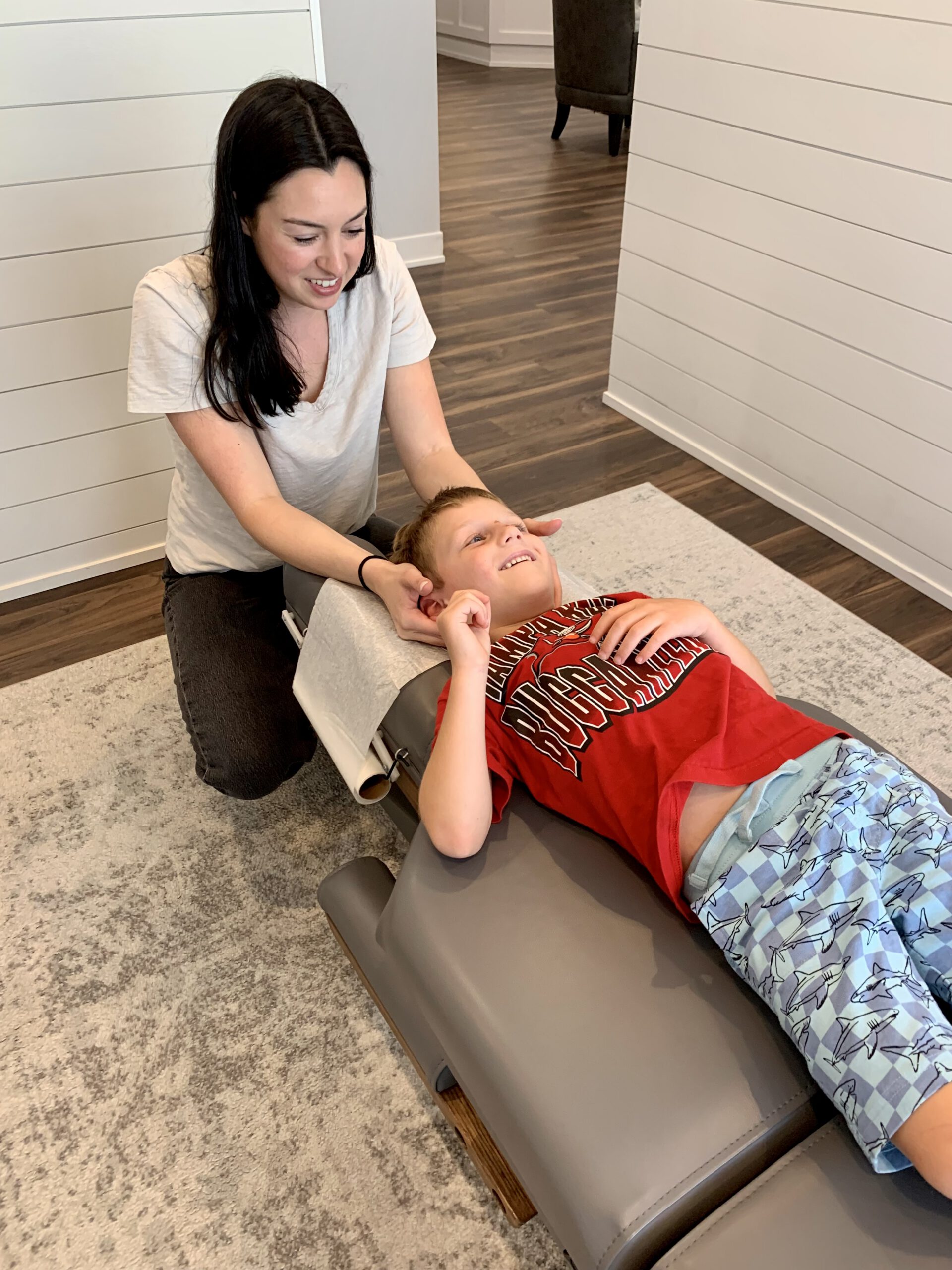
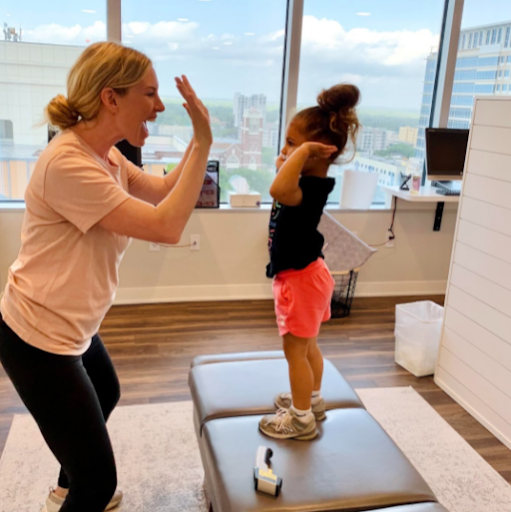
We never rush a child into care. If a child won’t get on the table, we get on the floor with them. We might start in the toy area and just hang out for a while, letting them get comfortable with the space and with us. We might have mom hold them for the first few visits. We follow the child’s lead completely.
For children with sensory sensitivities, we’re mindful of sound, touch, and environment. Our St. Petersburg office is intentionally designed to feel calm and welcoming, not clinical. We’ve worked with children who were initially resistant and became enthusiastic about their visits once trust was built.
Building that trust is part of the work. And it’s some of our favorite work.
What Should Parents Look For? Signs the Nervous System Needs Support
Whether or not your child has a formal diagnosis, here are signs that their nervous system may be running on overdrive:
- Difficulty with transitions -meltdowns when routines change
- Emotional regulation challenges that feel bigger than the situation warrants
- Sensory sensitivities to textures, sounds, lights, or crowds
- Difficulty focusing or sitting still, even when they’re trying
- Sleep challenges- difficulty falling asleep, staying asleep, or waking rested
- Frequent illness or slow immune recovery
- Anxiety (especially in girls) or hyperactivity (especially in boys)
- History of colic, reflux, ear infections, or constipation as an infant
These signs, especially in combination, are the nervous system asking for support. At Blossom Family Chiropractic in St. Petersburg, we use our INSiGHT CLA scanning technology to assess exactly how the nervous system is functioning- giving us an objective picture that goes beyond symptoms alone.
A Note From Dr. Savy
I want every parent reading this to know something: your child is not broken. Their brain is not the problem. Their nervous system is doing exactly what it learned to do in response to stress and it just needs support in learning a different way.
The families who come to Blossom Family Chiropractic in St. Petersburg aren’t coming as a last resort. Well some of them are, at first. But the ones who stay tell us they wish they’d found us sooner. Not because chiropractic is magic. But because addressing the root cause, the nervous system, changes everything downstream.
If your child is struggling, we’d love to meet them. And we’d love to meet you.
Frequently Asked Questions About Chiropractic Care for ADHD and Sensory Challenges
Can chiropractic care help a child with ADHD?
Chiropractic care doesn’t treat ADHD as a diagnosis, but it directly supports the nervous system function that underlies many ADHD symptoms. When the nervous system is less stressed — when the brake pedal is more accessible — children often show improved focus, calmer behavior, better emotional regulation, and easier transitions.
What is nervous system dysregulation in children?
Nervous system dysregulation means the autonomic nervous system is chronically imbalanced toward the sympathetic (fight-or-flight) state. Children in this state have difficulty regulating emotions, tolerating sensory input, focusing, and transitioning. At Blossom Family Chiropractic in St. Petersburg, we work to restore balance between the sympathetic and parasympathetic branches through gentle, nervous system-focused chiropractic care.
Is chiropractic care safe for children with sensory sensitivities?
Absolutely. At Blossom Family Chiropractic in St. Petersburg, we work at every child’s pace and comfort level. Adjustments are extremely gentle and we never begin care until the child feels safe. Many sensory-sensitive children become some of our most enthusiastic patients once trust is established.
How long before we see changes in behavior or focus?
Many families notice improvements in sleep, emotional regulation, or sensory tolerance within the first few weeks of consistent care. Longer-term changes in focus, language, and behavior typically develop over months. Every child is different, and we track progress using our INSiGHT CLA scanning technology so families can see objective changes alongside the ones they feel at home.
What is the connection between infant colic, ear infections, and later ADHD?
Dr. Ford describes a “perfect storm” progression: nervous system dysregulation that begins at or before birth often shows up as colic and reflux in infancy, ear infections and immune challenges in toddlerhood, and sensory or behavioral challenges in school-age years. These aren’t separate problems, they’re the same root cause expressing itself at different developmental stages. Addressing it early gives children the best possible foundation.
Can chiropractic care help alongside other therapies like OT, speech, or ABA?
Yes- and many families find that chiropractic care enhances the effectiveness of their other therapies. When the nervous system is less stressed and more regulated, children are often more receptive and responsive in their other therapeutic work. We collaborate comfortably alongside occupational therapists, speech therapists, and other providers who support your child’s development.
Dr. Savannah (Savy) Ford is the founder and CEO of Blossom Family Chiropractic in St. Petersburg, FL. She is Webster Technique certified, ICPA-trained with 250+ hours of advanced pediatric education, and a graduate of Life University with honors. She was featured on WFLA News Channel 8’s Bloom Tampa Bay discussing ADHD, sensory challenges, and nervous system care for children.
📞 727-498-5643 | blossomfamilychiropractic.com | 360 Central Ave Suite 1200, St. Petersburg, FL 33701